
Village Meadows Elementary School
NOTE: Since the reporting of this case study, the Sierra Vista Unified School District Governing Board voted to close Village Meadows due to declining enrollment. The educators featured in this report are now serving students within the district at Pueblo del Sol Elementary School, where they continue the outstanding work recognized here.
Village Meadows Elementary School
Sierra Vista Unified School District | Phoenix, AZ
Bright Spot: Coaching and Aligned Instruction Drive Literacy Gains in Cochise County
At Village Meadows Elementary in Sierra Vista, one literacy question drives every lesson, meeting, and small-group intervention: “What do we expect kids to know, and how will we know when they know it?”
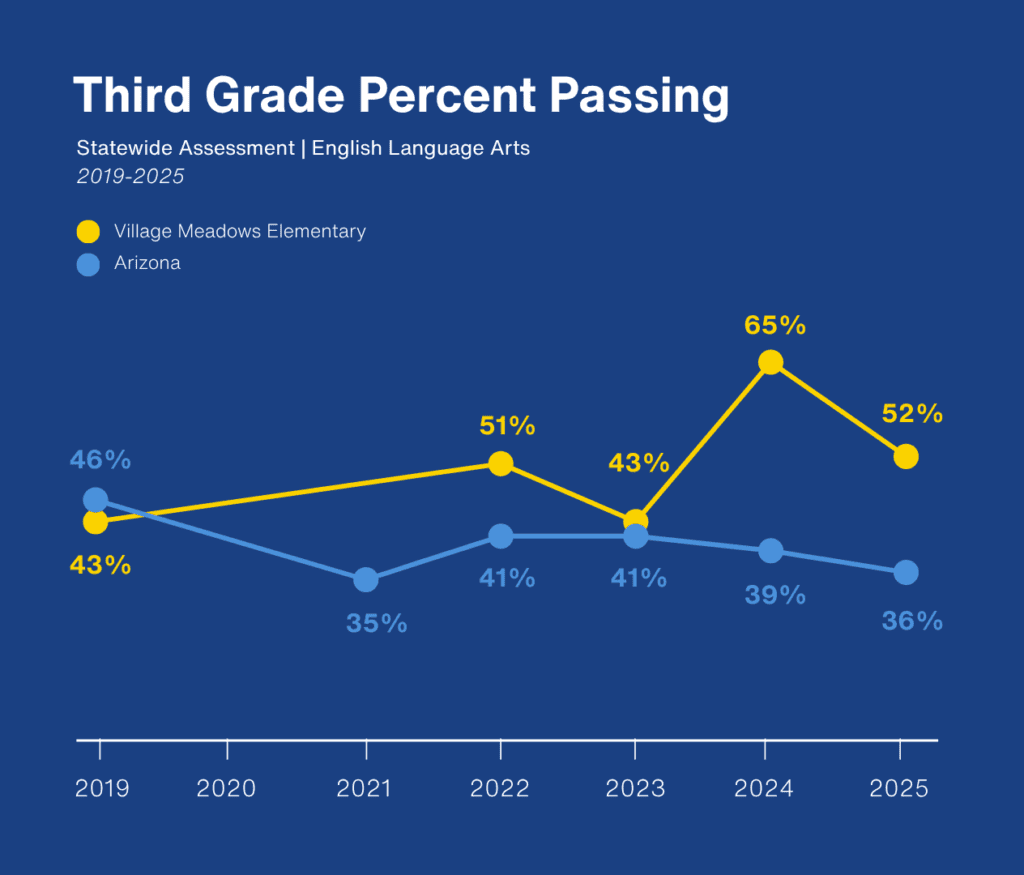
Part of the Read On Cochise County community, Village Meadows is a Title I school where 85% of students qualify for free or reduced lunch. Yet for years, the school has outperformed Arizona and countywide averages on the state's third-grade English Language Arts assessment.
In 2024, 65% of Village Meadows third graders passed, compared to 39% statewide and 34% countywide. In 2025, Village Meadows held strong at 52%, still well above state and county passing rates. Among the most striking progress: in 2024, Village Meadows' economically-disadvantaged third graders passed at 52%, exceeding the state and county averages for all students. While 2025 results moderated, in line with statewide trends, the multi-year trend shows a school consistently making progress and closing gaps for economically-disadvantaged students.
Behind these results is a deliberate system that the school’s team has built over two years of collaborative work. They developed “the ladder” — a learning progression tool that maps essential ELA standards from foundational steps to full mastery.
Every teacher, in every classroom, is teaching the same foundational skills in the same sequence and asking the same questions. “It doesn’t matter if a student is in my class or the other second-grade class. We are on the same progression with the standard,” explained second-grade teacher Michele Quinones.
This coordinated and consistent effort is bolstered by an instructional coach, Kristy Holston, providing the kind of coaching capacity that Arizona Literacy Plan 2030 seeks to expand. Her role is to see what individual teachers cannot - patterns across classrooms, schoolwide trends in data, and skill gaps — and to turn it into actionable information. “You can have all the data in the world,” Holston said, “but if you don’t do anything with it, it really doesn’t matter.” The real work, she explained, is in the “now what.”
Here’s what “now what” at Village Meadows looks like: every week, grade-level teams meet to work through four Professional Learning Community questions:
- What do we expect kids to know or be able to do?
- How do we know they know it?
- What do we do for students who didn’t get it?
- What do we do for those who did?
Teachers bring student work to the table, identify trends and skills gaps, and leave with a concrete plan for the week. Then they reassess and do it again.
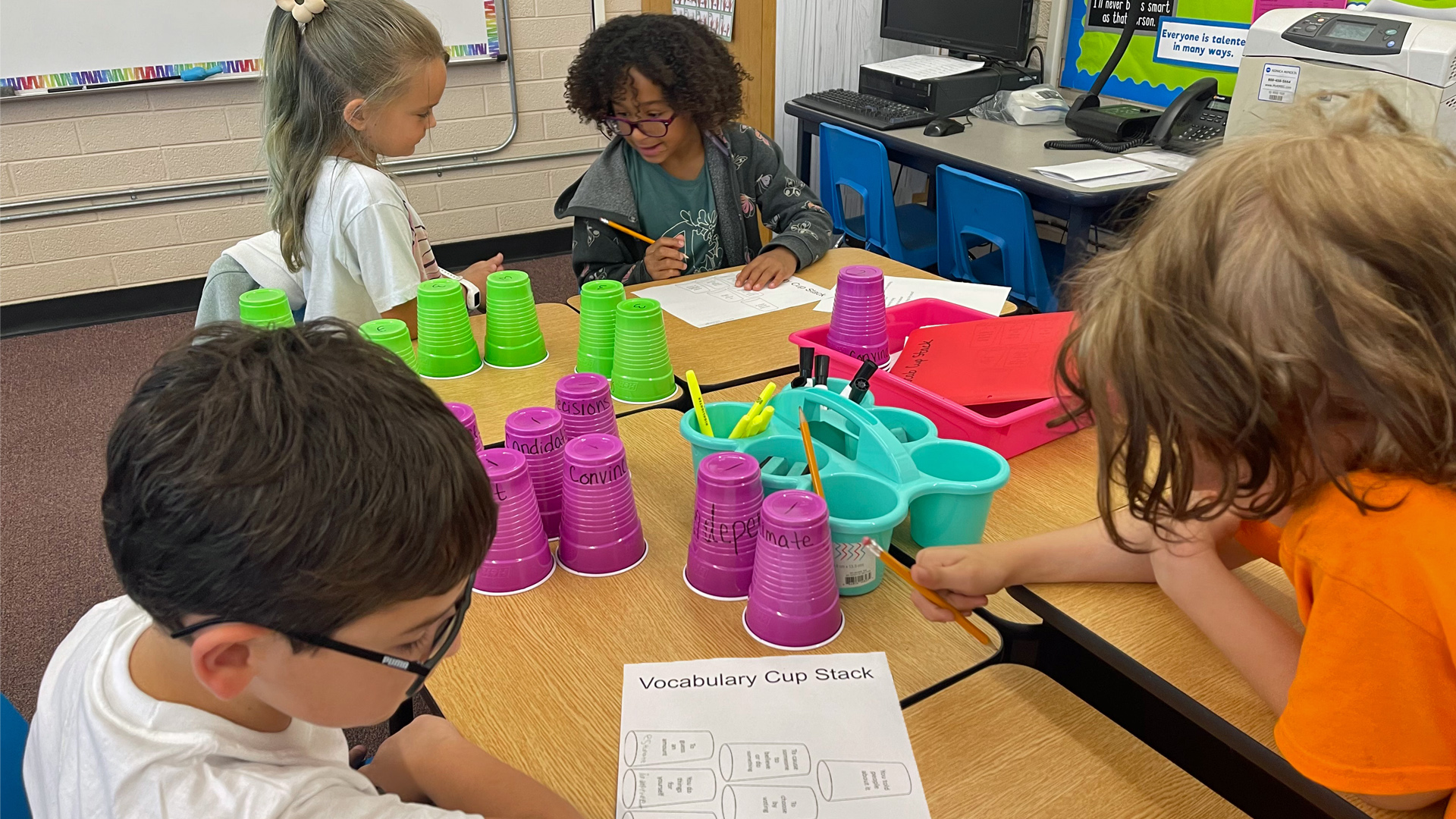
Back inside the classroom, those plans play out in deliberate instruction and interventions, like small groups of students rotating through centers: a teacher table, word work, and writing. “We’re talking about collaboration, hands-on, engaging, authentic tasks,” Holston said. Students have twenty minutes with a teacher targeting the specific needs of that group, and then students continue practicing. The payoff is engaged students, excited about being in the classroom and about reading. “I think it’s had an impact on our attendance because kids are more motivated to come.”
For students who arrive without the background knowledge, vocabulary, or other foundational skills to access grade-level text, teachers have implemented proactive strategies: pre-teaching content a full week ahead. When those students arrive at the teacher's table, Wambach noted, they are motivated because they have learned the content and are excited and confident.
In addition to the parallel work happening across classrooms, this coordination also runs vertically, with grade-level teams aligning expectations so students arrive in each new grade ready for what comes next. For example, second-grade teacher Quinones began increasing writing demands after learning from third-grade colleagues what students needed to arrive ready. Kindergarten students move up already knowing how to function in centers, so teachers can spend more time on learning and less on classroom management.
At the heart of the school is a non-negotiable belief, culture, and commitment that every student can progress and become a strong reader. “Every one of them can meet that goal, every one of them can attain it — with our support, with another teacher’s support, with their friends’ support,” said third-grade teacher Danielle Frasier.
The strategies at the heart of Arizona Literacy Plan 2030 — literacy coaching, evidence-based literacy instruction, and data-driven approaches — have taken hold at Village Meadows. As Frasier shared, “I think any school can do what we’re doing.” With everyone on the same page, this shared effort to provide effective literacy instruction for every student is paying dividends for the whole school community.
Read On Arizona met with several leaders and educators at Village Meadows Elementary to learn about the school’s approach to literacy. We thank them for their time and celebrate their accomplishments.
- Michelle Wambach, former principal, now director of exceptional student services at Sierra Vista Unified School District
- Michele Quinones, 2nd grade
- Joan Jurik, kindergarten teacher
- Kristy Holston, instructional coach
- Danielle Frasier, 3rd-grade teacher
- Mary Cangiolosi, 1st grade